
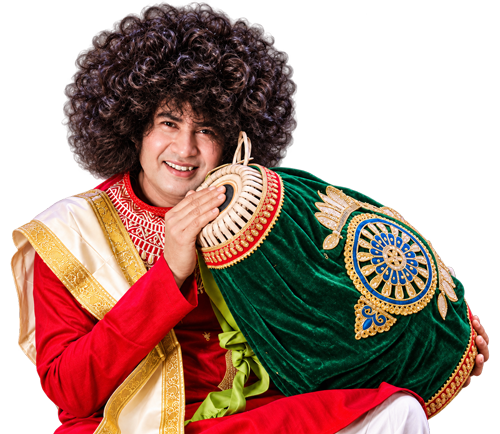
Dr. Harekrishna Halder is one of India’s foremost exponents of the ancient art of Mridanga, or Shreekhol. A distinguished musician, scholar, educator, author, researcher and cultural ambassador, his life has been deeply connected with the preservation, practice and global promotion of India’s traditional musical heritage.
Born into the illustrious Monoharshahi Gharana, a renowned lineage of traditional Bengali musicians, Dr. Halder inherited a rich musical legacy. That inheritance became the foundation of a lifelong mission: to preserve the authentic tradition of Shreekhol while helping it find renewed recognition among contemporary audiences in India and across the world.
Years of
Musical
Excellence
Students Trained
(Free Education)
Performances in
Major Platforms
All India Radio &
Doordarshan Artist
Award &
Honours
Books
Authored
Began training at the age of 4 under his father, Late Shri Shyamapada Halder.
Trained under eminent gurus - Shri Krishnadas Bairagya, Shri Brindaban Das Bairagya, Shri Jagabandhu Das Bairagya.
Developed a unique style rooted in tradition, spirituality and deep scholarship.
Professor at Rabindra Bharati University (Since 2007) mentoring generations of students.
An "A" Grade Artist of All India Radio Documented the art of Shreekhol, and Doordarshan.
Dedicated to preserving, promoting and teaching the Guruparampara tradition of Shreekhol and Kirtan.
Elevated Shreekhol from a Kirtan accompaniment to a respected solo concert instrument.
Performed at prestigious national & international events with large ensembles of students.
Founder of Mridangam Dankuni & Dr. Harekrishna Halder Shreekhol Academy empowering thousands of students.
Documented the art of Shreekhol, Taal, Kirtan, Bols & Banis through in-depth research and publications.
Encouraged women to learn Shreekhol and provided free training to children from underprivileged communities.
Conducted lectures, demonstrations and workshops at leading universities and cultural institutions across India.


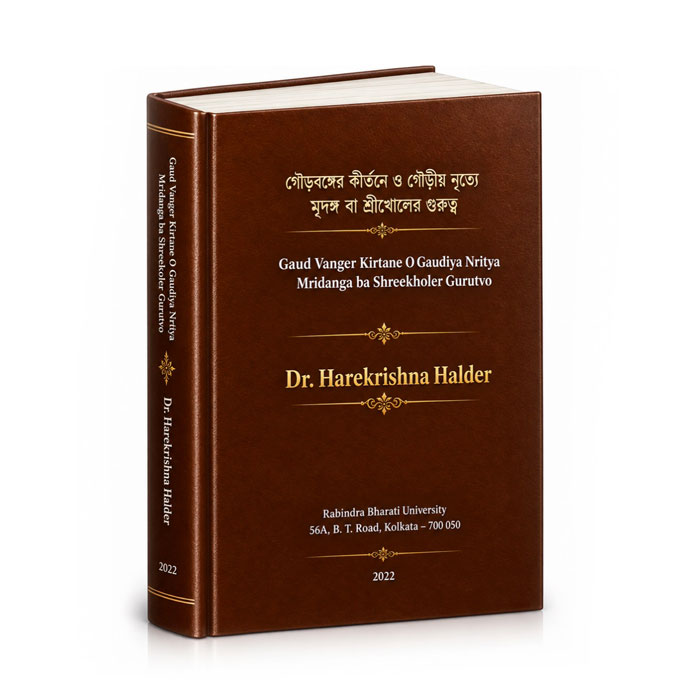
Valuable reference books on Shreekhol, Taal, Kirtan, Bols, Banis and Indian percussion traditions.
Dr. Harekrishna Halder’s relationship with music began remarkably early. At just four years of age, he started his musical training under the guidance of his father, Late Shri Shyamapada Halder.
Under his father’s careful guidance, he received rigorous training in Indian Classical Music, Traditional Bengali Kirtan and Shreekhol.
As his musical journey developed, Dr. Halder further refined his artistry under eminent gurus including Shri Krishnadas Bairagya, Shri Brindaban Das Bairagya and Shri Jagabandhu Das Bairagya.
Decades of disciplined practice, scholarship and spiritual devotion eventually shaped his distinctive approach to Shreekhol performance – an approach that remains firmly rooted in tradition while also exploring the instrument’s wider artistic possibilities.
Today, Dr. Harekrishna Halder is internationally recognised as a Shreekhol maestro.
He is an ‘A’ Grade Artist of All India Radio and Doordarshan, a distinction that reflects his standing as a professional performer of Indian traditional music.
Since 2007, he has been serving as a professor at Rabindra Bharati University, where his contribution extends beyond performance into higher education, mentoring students and researchers and sharing his understanding of India’s traditional musical heritage.
His combination of performance excellence and scholarly engagement has earned him recognition from respected musicians, academics and cultural institutions in India and abroad.
Dr. Halder’s contribution to Indian music and culture has been recognised through several prestigious honours.
Among these is the Sangeet Samman Award, conferred by the Chief Minister of West Bengal. He is also a recipient of the Junior Fellowship awarded by the Ministry of Culture, Government of India.
Beyond formal awards, Dr. Halder has received several significant titles and positions of recognition. Gajapati Maharaj conferred upon him the title ‘King of Shreekhol’ in recognition of his extraordinary mastery of the instrument.
Audiences have widely revered him as ‘Shreekhol Samrat’ for his artistry and lifelong dedication. He has also been appointed as a Judge for the West Bengal State Students’ and Youth Festival.
For his exceptional contribution to preserving, promoting and bringing global recognition to the Guruparampara Shreekhol tradition, he has also been respectfully addressed as the ‘Maharaja of Shreekhol’ by the Hon’ble Governor.
Dr. Harekrishna Halder’s contribution to Shreekhol extends far beyond the concert stage.
As an author and researcher, he has worked extensively toward documenting and preserving the history, practice and traditional knowledge surrounding the instrument.
His books include Banger Shreekhol, published by the Information & Cultural Affairs Department, Government of West Bengal; Mridanga Manjuri, published by Mridanga Ashram; and Ankur and Nabin, published by the Dr. Harekrishna Halder Shreekhol Academy.
These works have become valuable reference materials for students, performers and researchers interested in Indian percussion traditions.
His writings explore areas including the history of Taal, the significance of Mridanga in Indian Classical Music and Kirtan, and the authentic Bols and Banis of Shreekhol.
Alongside his literary work, Dr. Halder has made significant research contributions to the study of Indian music.
His research has been published by the Ministry of Culture, Government of India; Rabindra Bharati University; and the Journal of the Kolkata Society for Asian Studies.
Through this body of work, he has contributed to the scholarly understanding of Shreekhol and traditional Indian musical practices, helping create a stronger academic foundation for a musical tradition that has often been transmitted primarily through Guruparampara.
For Dr. Harekrishna Halder, preserving Shreekhol has never been limited to his own performances.
He founded institutions dedicated to ensuring that the tradition continues through future generations, including the Dr. Harekrishna Halder Shreekhol Academy and Mridanga Ashram.
Through his institutional initiatives, thousands of students have received training in Shreekhol and related traditional arts.
His work places particular emphasis on disciplined artistic practice, spiritual values, cultural continuity and making traditional musical education accessible to younger generations.
His institutions also provide free education to thousands of students, including women and underprivileged children, helping ensure that economic circumstances do not prevent talented students from connecting with this musical heritage.
Transforming Shreekhol from Accompaniment to a Concert Instrument
One of the most significant aspects of Dr. Harekrishna Halder’s contribution is his role in transforming public and artistic perceptions of the Shreekhol.
Historically, Shreekhol was largely associated with Kirtan accompaniment.
Through Dr. Halder’s pioneering efforts, the instrument gained greater recognition as a solo concert instrument and began finding a place in duet performances, fusion projects and other diverse musical forms.
His work expanded the artistic possibilities of Shreekhol without abandoning its traditional foundations.
This transformation also created new possibilities for Shreekhol musicians themselves. Artists who had previously been recognised primarily as Kirtan accompanists increasingly found opportunities to establish their own identities as independent musicians and performers.
In this sense, Dr. Halder’s work has contributed not only to the evolution of the instrument but also to the professional growth of the community associated with it.
Landmark Musical Productions
Dr. Halder has conceived and directed several important productions that have helped introduce audiences to the rhythmic, artistic and spiritual possibilities of Shreekhol.
These include Harekrishna Badyakala, Shreekhol Sankirtan and The Rhythm of Soil, along with numerous other innovative presentations.
Through solo recitals, fusion performances, large-scale Shreekhol Sankirtan presentations and collaborative projects, he has worked to demonstrate that the instrument can retain the authenticity of its Guruparampara tradition while speaking powerfully within a contemporary performance environment.
A Musical Partnership with Dr. Parbati Halder
Dr. Halder’s cultural journey has also been enriched through collaboration with his wife, the eminent Kirtan vocalist Dr. Parbati Halder.
Together, they have introduced diverse audiences to the artistic and spiritual richness of Shreekhol and Kirtan, helping carry this traditional Bengali musical culture to audiences around the world.
Dr. Harekrishna Halder has represented India’s musical heritage at numerous prestigious national and international events.
His notable performances include Ayodhya Ram Mandir on 22 January 2024; Vrindavan Prakash Mahotsav with 501 students; Veda Yagga, Mayapur; World Cultural Festival, Delhi with 1,000 students; Divya Samagam, Puri with 501 students; Sanatan Sanskriti Utsav, London; Sri Ram Mandir, England; Bengali Associations, Manchester; Sanatan Festival at Mayfair Venue; World Rhythm Festival 2019 alongside internationally acclaimed percussion maestros; A Homage to Abbaji Ustad Alla Rakha organised by Ustad Zakir Hussain; Kumbh Mela; Gita Jayanti Utsav; Kashi Vishwanath Temple; Lingaraj Temple; Vande Bharatam Nritya Utsav; Bengal Business Summit; G20 Summit; Kolkata Film Festival; Sangeet Research Academy; Classical Music Festival; Bangladesh Utsav, as well as numerous other distinguished cultural festivals and institutions in India and overseas.
Many of these presentations have involved ensembles numbering in the hundreds, demonstrating not simply Dr. Halder’s individual artistry but also his extraordinary ability to train, organise and inspire large communities of Shreekhol students.
Dr. Halder’s performances are known for rhythmic sophistication, tonal refinement, spiritual depth and exceptional improvisational creativity.
His command over rare and traditional Tālas has received admiration from eminent musicians, scholars and connoisseurs of Indian classical and devotional music.
Through his performances and innovative presentations, he has helped enhance both the artistic stature and public appreciation of Shreekhol as one of India’s ancient percussion instruments.
Education has remained a central part of Dr. Halder’s mission.
He has conducted numerous lecture-demonstrations and workshops at prestigious institutions including the University of Delhi, Banaras Hindu University, Visva-Bharati University, Indira Kala Sangeet Vishwavidyalaya at Khairagarh, University of Lucknow, Jadavpur University, Tripura University and Gauhati Music College, along with many other universities.
Through these academic engagements, students, researchers and music enthusiasts have gained deeper access to knowledge about India’s ancient musical heritage and the Shreekhol tradition.
Dr. Halder’s contribution is not limited to personal excellence as a musician.
His larger achievement lies in expanding the cultural and artistic space occupied by Shreekhol itself.
A traditional instrument once primarily identified with Kirtan accompaniment is now being performed as a solo instrument and across multiple musical genres.
His innovations have inspired a new generation of artists and helped numerous musicians develop independent professional identities.
At the same time, thousands of women are learning and promoting the Shreekhol tradition under his guidance, significantly broadening participation in the art form.
During the time of Śrī Chaitanya Mahaprabhu, the Mridanga became widely known as the Shreekhol and served as a principal instrument in spreading the message of Harināma Saṅkīrtana.
Over time, however, the distinct identity and heritage associated with Shreekhol gradually faded.
For more than four decades, Dr. Harekrishna Halder has dedicated his life to reviving the authentic Guruparampara tradition of Shreekhol.
Through performances, research, publications and free training – particularly for underprivileged children – he has worked to preserve this sacred legacy while presenting it to younger generations in a way that remains contemporary yet deeply rooted in tradition.
Another significant dimension of Dr. Halder’s work has been his encouragement of women to learn and perform the Shreekhol.
Inspired by the inclusive spirit of the Bhakti tradition, he has actively opened opportunities for women to engage seriously with the instrument.
His daughter, Ronjita Halder, is herself an accomplished Shreekhol artist, and her achievements have helped inspire numerous young women to embrace the tradition.
Today, many of Dr. Halder’s female disciples perform on respected stages, contributing meaningfully to the continuity and expansion of Shreekhol culture.
Dr. Halder’s work has also influenced how families perceive Shreekhol as a professional musical path.
Parents who once found it difficult to imagine their children pursuing careers as Shreekhol players are increasingly becoming enthusiastic about such possibilities.
This change has been driven by the opportunities Dr. Halder has helped create through sustained dedication, hard work and perseverance.
For years, the Shreekhol was sometimes misunderstood or disparaged, with some people mockingly referring to the instrument simply as ‘Dhol.’
According to the biographical account, this distorted usage eventually influenced younger generations, resulting in incorrect pronunciation and identification of the instrument.
Dr. Halder has actively worked against this misconception.
Through education and cultural advocacy, he has sought to restore public awareness of the instrument’s proper name, identity and cultural significance.
His sustained efforts have contributed to a noticeable shift, with increasing numbers of people correctly recognising the instrument as ‘Shreekhol.’
Its name carries the honorific ‘Shree,’ signifying reverence and auspiciousness and giving the instrument a distinctive identity within Indian musical heritage.
Through this lifelong commitment, Dr. Halder has worked to restore the dignity and rightful cultural place of Shreekhol.
His role therefore extends beyond that of a musician. He has also become an advocate for the preservation and appreciation of India’s traditional cultural heritage, particularly the musical heritage of Bengal and India.
Dr. Harekrishna Halder regularly conducts free workshops and educational camps in rural and remote communities.
These initiatives provide systematic training in the authentic Guruparampara tradition of Shreekhol and Kirtan.
A particular focus is placed on economically disadvantaged children and young musicians, giving them opportunities to develop their abilities and eventually become custodians of this cultural tradition.
Through Dr. Halder’s institutions, more than 20,000 students, including 5,927 women and many underprivileged children, have received free training in Shreekhol, Kirtan and other traditional art forms.
The scale of this work reflects the educational and social dimension of his musical mission.
For Dr. Halder, preserving heritage means creating future practitioners – not simply preserving memories of the past.
Dr. Halder has also established a strong presence on social media and is described as being among the most widely followed musicians in his field.
Through digital platforms, people across different parts of the world are becoming increasingly aware of the Guru-Parampara tradition and its cultural significance.
His digital presence has helped connect international audiences with the traditional musical culture of Bengal and India, contributing to greater recognition and appreciation of this heritage across geographical boundaries.
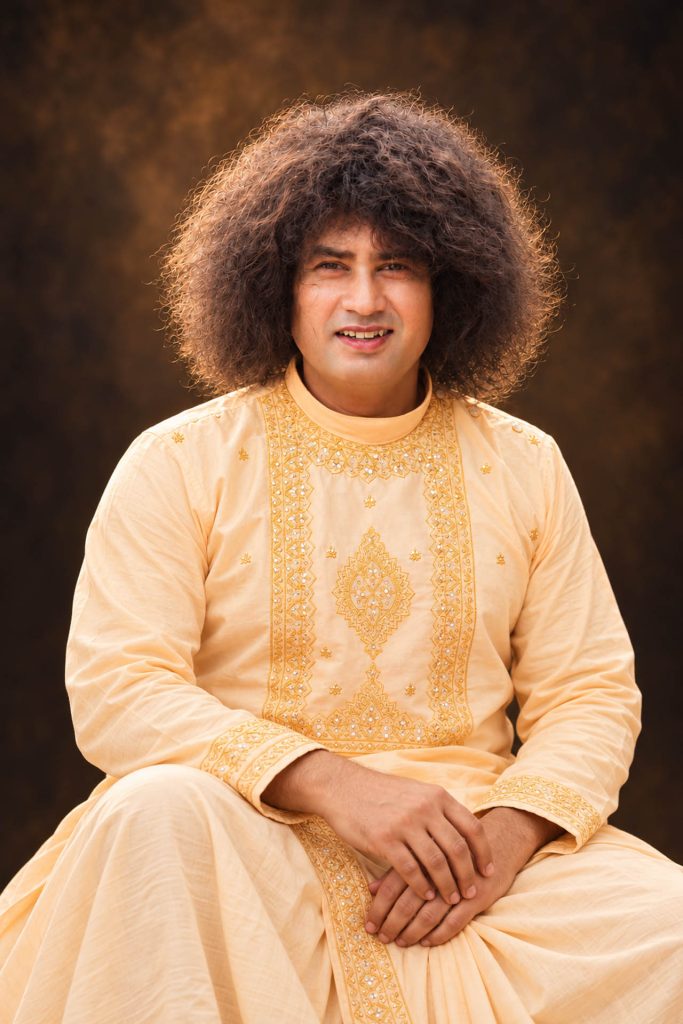
Dr. Harekrishna Halder is also recognised for his distinctive appearance and personal style.
His traditional attire and characteristic hairstyle have become closely associated with his identity as a Shreekhol performer.
His influence can be seen among many Shreekhol players who have adopted elements of his dress and hairstyle, reflecting the distinctive presence he has developed within the Shreekhol community.
Speaking about the influence of his work, Dr. Halder stated:
“If any individual, particularly a Shreekhol player, derives benefit from engaging with my work – be it my compositions, musical themes, books, research papers, lectures, or even my looks – that represents the greatest blessing and accomplishment of my life.”
The statement reflects a philosophy that reaches beyond personal recognition. For Dr. Halder, the continuation and growth of the tradition through others represents an important measure of accomplishment.
Dr. Harekrishna Halder is also recognised for his distinctive appearance and personal style.
His traditional attire and characteristic hairstyle have become closely associated with his identity as a Shreekhol performer.
His influence can be seen among many Shreekhol players who have adopted elements of his dress and hairstyle, reflecting the distinctive presence he has developed within the Shreekhol community.
Speaking about the influence of his work, Dr. Halder stated:
“If any individual, particularly a Shreekhol player, derives benefit from engaging with my work – be it my compositions, musical themes, books, research papers, lectures, or even my looks – that represents the greatest blessing and accomplishment of my life.”

Harekrishn Haldar is a distinguished artist, teacher and cultural ambassador preserving the divine rhythm of Srikhol and Mridanga and taking it to the world stage.